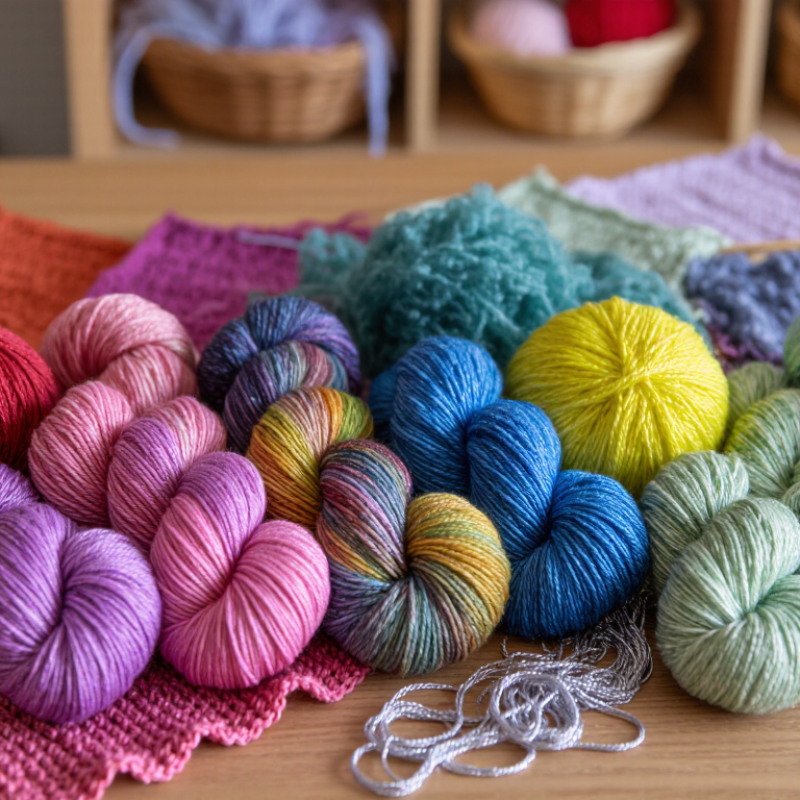
Color Yarn is yarn produced in a selected shade, pattern, or multi-colored effect. It can transform a plain scarf into something vivid and personal. The color may come from solid dyeing, blended fibers, gradual gradients, or short repeating sections. Each method changes how the finished fabric looks. A red wool yarn may appear deep in a ball but softer when knitted loosely. Lighting can also alter perception.
Available types include solid, variegated, self-striping, ombré, heathered, neon, and hand-dyed yarns. Wool offers warmth and elasticity, while cotton feels cooler and creates clearer stitch definition. Acrylic is often affordable, washable, and practical for everyday projects. Blended yarns combine useful qualities, although their behavior can be less predictable. Texture matters too. Bouclé, chenille, and metallic yarns create distinctive surfaces but may hide small stitch errors.
Choosing Color Yarn requires more than liking the shade. Check the fiber content, recommended needle size, washing instructions, and dye-lot information. Skeins from different dye lots may show visible differences. A small swatch is worth making. It reveals the true color, drape, and stitch appearance. I have learned that online images are not fully reliable; screens can shift blue toward purple. Even experienced crafters sometimes misjudge a palette. That is normal. A thoughtful choice balances appearance, comfort, care requirements, and the project’s intended use.
Color Yarn Defined: Fiber, Twist, Count, Dye, and Color Structure
Color yarn is yarn whose visible hue comes from dyed fibers, dyed yarn, or a planned color combination. Its character begins with fiber. Cotton feels dry and breathable, while wool offers warmth and elastic recovery. Polyester usually improves strength, color retention, and drying speed. Textile Exchange’s Materials Market Report 2024 estimates global fiber production reached about 124 million tonnes in 2023, with synthetic fibers forming the largest share. That scale makes fiber selection a practical quality decision, not merely a design preference.
Twist controls how fibers hold together. Low-twist yarn feels soft but may pill or lose shape. High-twist yarn feels firmer and can create a sharper surface. Count describes yarn fineness; ISO 2060 provides standard methods for measuring linear density. A finer count can produce delicate fabric, but it may require careful processing. Dye choice affects shade depth, wash durability, and lightfastness. The USDA’s Cotton: World Markets and Trade report also shows why cotton supply remains commercially important, with global production measured in more than 100 million bales annually. Color structure adds another layer. Solid yarn has one even shade, while mélange, heather, space-dyed, and gradient yarns combine multiple tones through blending or sectional dyeing. The boundary is not always clean. A “blue” yarn may contain several blue fibers, and photographs can hide that variation. Small sample checks remain essential.
Fiber Categories and Market Share: Polyester 54% and Cotton 22% in 2022
Color yarn is yarn produced with a visible hue, either before spinning or after the yarn is formed. Manufacturers commonly use polyester, cotton, acrylic, wool, rayon, and blended fibers. Each option changes softness, strength, shine, moisture handling, and color stability.
Textile Exchange’s Materials Market Report 2023 estimated global fiber production at about 116 million tonnes in 2022. Polyester represented 54% of output, while cotton accounted for 22%. This gap is significant. Polyester yarn often offers strong abrasion resistance, quick drying, and consistent color across large production runs. Cotton yarn feels cooler and more natural against the skin, but it can shrink, crease, and fade faster without careful processing. In practical sampling, a polyester cone may keep a bright red shade, while cotton can show slight tonal variation between lots.
Color yarn is available as solution-dyed, stock-dyed, package-dyed, or piece-dyed yarn. Solution dyeing adds pigment before some synthetic fibers are extruded, improving color retention. Package dyeing colors wound yarn evenly, which helps knitting and weaving applications. Stock dyeing can create blended or heathered effects before spinning.
The 54% polyester share should not be read as a quality ranking. It mainly reflects scale, cost, and broad industrial demand. Cotton’s 22% share remains substantial, especially where breathability and tactile comfort matter. The data is useful, but market shares cannot replace hands-on testing under real washing, light, and tension conditions.
What Is Color Yarn and What Types Are Available?
Global fiber categories and market share, 2022
Color yarn is yarn that has been dyed or produced with colored fibers before or during textile manufacturing.
In 2022, polyester represented 54% of the fiber market and cotton represented 22%.
The remaining 24% consisted of other fiber categories, including viscose, nylon, acrylic, wool, and specialty fibers.
Yarn Count Explained Through Tex, Denier, and Nm Under ISO 1144
Color yarn is textile yarn produced in a chosen shade before or after spinning. Common types include spun yarn, filament yarn, mélange yarn, and space-dyed yarn. Their appearance differs under light, tension, and moisture. Yarn count also changes how a color surface looks. A finer yarn creates a softer visual texture, while a heavier yarn appears denser and more solid.
ISO 1144 explains standard yarn numbering systems, including tex, denier, and metric count, or Nm. Tex measures grams per 1,000 meters. Denier measures grams per 9,000 meters. Nm shows how many meters weigh one gram. Therefore, higher tex or denier means heavier yarn. Higher Nm means finer yarn. Useful conversions are denier = tex × 9 and tex = 1,000 ÷ Nm. For example, 30 tex equals 270 denier and about Nm 33.3. Textile Exchange reported global fiber production at 124 million tonnes in 2023, showing why consistent yarn measurement matters across large supply chains. However, the conversion looks clean on paper. Actual yarn can vary because of twist, moisture, and testing conditions.
Tips: Check the supplier’s stated count system before comparing samples. Test a conditioned yarn, not a loose strand from a package. Record color, count, twist, and fiber content together. ISO 1144 supports comparison, but it does not replace laboratory verification. My practical mistake was trusting Nm alone; the fabric felt heavier because twist and construction changed the final result.
What Is Color Yarn and What Types Are Available? — Yarn Count Explained Through Tex, Denier, and Nm Under ISO 1144
Color yarn is yarn that has been colored during fiber production or yarn processing. Yarn count describes linear density or fineness; it does not indicate the yarn’s color.
Count conversion: Under the tex-based system referenced by ISO 1144, 1 tex is 1 gram per 1,000 metres. The equivalent relationships are: denier = 9 × tex, and Nm = 1,000 ÷ tex. Nm is the metric count expressed as metres per gram. Values above are nominal conversions; actual yarn specifications may vary by construction and manufacturing tolerance.
Color Classification: Solid, Mélange, Space-Dyed, Gradient, and Multicolor
Color yarn is produced by combining or arranging shades to create a specific visual effect in knitted or woven fabric. Solid yarn carries one consistent color, making it useful for clean garments, clear stitch patterns, and reliable color matching. Mélange yarn blends several fibers or tones before spinning. Its softly mixed appearance can hide minor pilling and add depth without looking busy.
Space-dyed yarn shows separate color sections along its length. These sections create stripes, blocks, or irregular pools as the yarn is worked. Gradient yarn changes gradually from one shade to another, often moving from pale blue to deep navy. Multicolor yarn contains several distinct colors, sometimes with sharp transitions and playful contrast. My first swatch looked different from the yarn ball because stitch tension changed the color spacing. That mistake still influences how I test new yarns.
Tips
Knit a small swatch before choosing a project. Check the yarn under daylight, not only warm indoor lighting. For space-dyed and multicolor yarns, use simple stitches so the colors remain visible. Gradient yarn needs careful planning, especially when joining skeins. Mélange can appear dull beside strong colors, although this depends on fiber texture and lighting. Touch the fabric after washing, too. Some colors become softer, while others lose definition.
Colorfastness Testing: ISO 105 Methods and CIE L*a*b* Measurement
What Is Color Yarn and What Types Are Available?
Color yarn is yarn produced in a controlled shade for knitting, weaving, or textile manufacturing. Its performance depends on fiber type, dye selection, and finishing conditions. However, a bright shade is not necessarily a durable shade. Testing reveals what happens after washing, rubbing, sunlight, or perspiration.
ISO 105 methods provide structured procedures for these checks. ISO 105-C06 evaluates colorfastness to domestic or commercial washing. ISO 105-X12 measures color transfer during rubbing, using dry and wet conditions. ISO 105-E04 examines resistance to perspiration, while ISO 105-B02 assesses light exposure. Test samples should be conditioned before evaluation. Record the yarn lot, dye depth, temperature, moisture level, and test duration. Small handling differences can affect results.
CIE L*a*b* measurement adds numerical color evidence. L* represents lightness, from dark to light. Positive a* indicates red, while negative a* indicates green. Positive b* indicates yellow, and negative b* indicates blue. A spectrophotometer can compare an original yarn with a tested sample. The color difference, often expressed as ΔE, helps quantify change. Visual grading with grey scales remains useful, because numbers do not always match human perception. A yarn may show an acceptable ΔE but still look uneven under store lighting. That limitation deserves attention. Testing is not perfect, especially when yarn texture scatters light or samples contain mixed fibers.
FAQS
Color yarn gets its visible shade from dyed fibers, dyed yarn, or planned color combinations. Its appearance can change under light, tension, and moisture.
Cotton feels dry and breathable. Wool feels warm and elastic. Polyester often improves strength, drying speed, and color retention. Fiber choice affects comfort, appearance, and durability.
Low twist feels soft but may pill or lose shape. High twist feels firmer and creates a sharper surface. Twist can also change fabric weight.
Tex measures grams per 1,000 meters. Denier measures grams per 9,000 meters. Nm shows meters per gram. Higher tex or denier means heavier yarn. Higher Nm means finer yarn.
Not completely. Twist, moisture, and fabric construction also matter. For example, 30 tex equals 270 denier and approximately Nm 33.3. I once trusted Nm alone. The finished fabric felt heavier than expected.
Solid yarn has one even shade. Mélange yarn blends several tones or fibers before spinning. Multicolor yarn contains distinct colors with stronger contrast. The boundaries can look unclear.
Space-dyed yarn has separate color sections along its length. It may create stripes, blocks, or irregular pools. Gradient yarn changes gradually between shades. Joining skeins can disturb the color flow.
Knit or weave a small swatch first. Check it under daylight. Wash the sample and inspect its softness and color definition. Keep stitch tension consistent. My first swatch changed noticeably. That was a useful mistake.
Conclusion
Color Yarn is yarn distinguished not only by its visible color, but also by its fiber composition, twist, count, dyeing method, and color structure. In the 2022 market overview, polyester represented approximately 54% of fiber use, while cotton accounted for about 22%, reflecting the importance of both synthetic and natural materials. Yarn fineness can be described through Tex, Denier, or Nm, with ISO 1144 providing a common framework for converting and comparing these measurements.
Color Yarn can be classified as solid, mélange, space-dyed, gradient, or multicolor, depending on how shades are arranged along or across the yarn. These structures create different visual effects in fabrics and finished products. Reliable color evaluation also requires colorfastness testing based on ISO 105 methods, while CIE L*a*b* measurements help describe color using lightness and chromatic coordinates. Together, fiber, count, structure, and testing determine a yarn’s appearance, performance, and suitability for specific textile applications.

 Yibang Textile